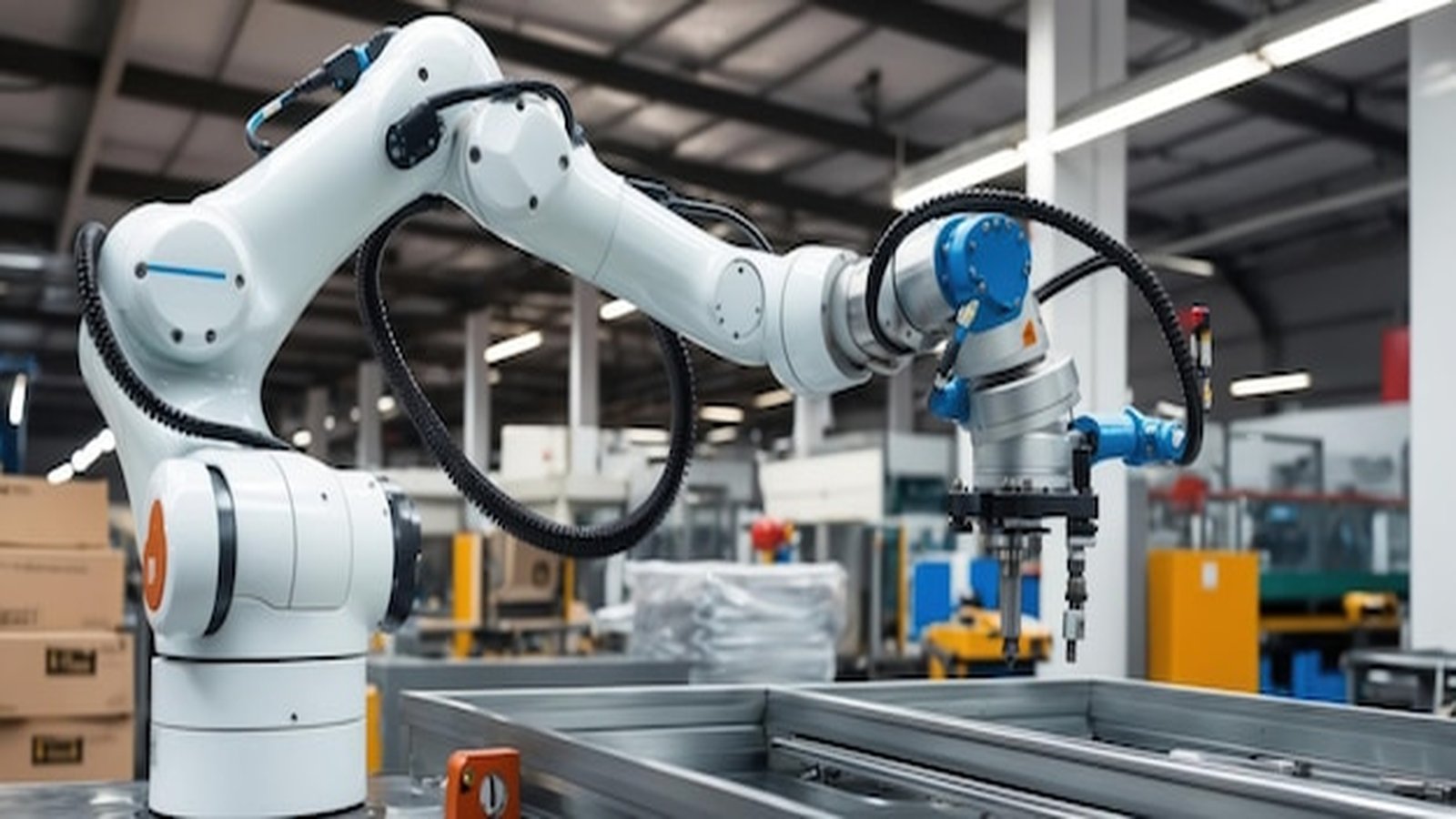
AI transforms the KNO₃ industry: smart manufacturing, optimized supply chains and precision agriculture
Artificial intelligence is reshaping the potassium nitrate industry from factory floor to farm field, delivering efficiency gains in manufacturing, logistics and on-farm application.
AI across the KNO₃ value chain
Artificial intelligence is no longer confined to the farm. It is reshaping every stage of the potassium nitrate industry, from raw material processing to logistics optimization to on-farm application. The cumulative effect is a supply chain that is becoming faster, more responsive and more efficient, with benefits that reach both producers and end users.
This article maps AI adoption across the three main stages of the KNO₃ value chain: manufacturing, distribution and agricultural application. It identifies where the technology is delivering real results versus where it remains aspirational.
Smart manufacturing
Process optimization
KNO₃ production involves exothermic reactions, crystallization, drying and granulation, each with multiple process variables that affect yield, product quality and energy consumption. Machine learning models trained on historical process data can optimize these variables in real time.
Haifa Group's production facility in Israel has deployed an ML-based process control system that continuously adjusts crystallization temperature, agitation speed and seeding rate based on incoming feedstock composition. The system has reduced off-specification product by 22% and cut energy consumption per tonne of KNO₃ by 8% since deployment in 2024.
Predictive maintenance
KNO₃ manufacturing equipment operates in corrosive, high-temperature environments where unplanned downtime is expensive. AI-based predictive maintenance systems analyze vibration, temperature and acoustic sensor data from pumps, crystallizers and dryers to predict failures before they occur.
SQM's Chilean operations use predictive maintenance algorithms that have reduced unplanned downtime by 35% across their KNO₃ processing lines, translating to improved supply reliability for customers.
Quality assurance
Near-infrared (NIR) spectroscopy combined with ML classification models enables real-time, inline quality analysis of KNO₃ product streams. Every tonne of product passing the analyzer is classified for moisture content, chloride levels and particle size distribution. Out-of-spec product is automatically diverted for reprocessing rather than reaching the warehouse.
Supply chain optimization
Demand forecasting
Agricultural fertilizer demand is seasonal and weather-dependent. AI demand forecasting models that incorporate weather predictions, satellite-derived crop condition data, commodity price trends and historical ordering patterns are helping KNO₃ distributors position inventory more accurately.
ICL's Polysulphate and specialty fertilizer division uses an AI demand-forecasting tool that improved order-fill rates by 12% and reduced dead stock by 18% across its European distribution network.
Logistics and routing
Moving KNO₃ from production facilities (often in Chile, Israel or Europe) to end markets worldwide involves multi-modal logistics: shipping, rail, truck. AI routing algorithms optimize vessel scheduling, port selection and inland distribution to minimize transit time and cost.
The technology is particularly valuable for managing the seasonal demand peaks that characterize fertilizer markets. Rather than pre-positioning large inventories at every regional hub, AI-optimized logistics can move product dynamically to where demand is emerging.
Pricing optimization
Dynamic pricing tools that account for feedstock costs, logistics, inventory positions and competitive activity are being adopted by major KNO₃ distributors. While growers may view this with skepticism, the practical effect has been more stable and transparent pricing in markets where these tools are deployed.
Precision agriculture applications
At the farm level, AI-driven KNO₃ management builds on the precision agriculture tools already in use:
Recommendation engines
AI platforms that integrate soil data, crop models, weather forecasts and satellite imagery to generate field-specific KNO₃ rate and timing recommendations. These systems outperform static recommendation tables because they adapt to in-season conditions.
Autonomous application
Autonomous fertigation controllers that adjust KNO₃ injection rates in real time based on sensor inputs (soil moisture, EC, plant canopy temperature). These systems are operating commercially in Israeli and Dutch greenhouse operations.
Yield prediction
ML models that predict yield outcomes under different fertilizer scenarios help growers evaluate whether increasing or decreasing KNO₃ rates would improve profitability. The models learn from the grower's own historical data, becoming more accurate over successive seasons.
For more detail on AI-driven fertilizer management at the farm level, see our earlier article on machine learning for KNO₃ optimization. For the technology behind precision variable-rate application, see our precision application article.
Case study: end-to-end AI in Chilean KNO₃
SQM's operations in Chile provide a window into end-to-end AI adoption:
- Mining: AI-guided brine extraction optimizes pump rates based on real-time brine concentration and weather (evaporation rate) data
- Processing: ML models control crystallization and granulation for consistent product quality
- Quality control: Inline NIR analysis classifies every batch
- Logistics: AI routing optimizes container allocation from Antofagasta port to global destinations
- Customer recommendations: SQM's digital platform provides AI-generated application recommendations for key crops and regions
The integrated approach has improved SQM's overall production efficiency by an estimated 10-15% while improving product consistency and delivery reliability.
Adoption barriers
Despite the clear benefits, AI adoption across the KNO₃ industry faces practical barriers:
- Data quality: ML models require clean, structured data. Many manufacturing facilities and farms have patchy historical records
- Integration: Connecting AI tools with existing process control systems, ERP platforms and farm management software is often harder than the AI development itself
- Skills: Operating AI systems requires technical skills that are scarce in both the fertilizer manufacturing and farming sectors
- Trust: Experienced plant operators and agronomists are understandably cautious about delegating decisions to algorithms. Building trust requires transparent models and gradual adoption
What it means for growers
- Better product quality: AI-driven manufacturing produces more consistent KNO₃ with fewer quality issues
- More reliable supply: Optimized supply chains reduce the risk of seasonal shortages
- Smarter recommendations: AI-powered advisory tools help growers get more value from every kilogram of KNO₃ applied
- Competitive pricing: Manufacturing and logistics efficiency gains should moderate long-term price increases
For the broader market trends shaping the KNO₃ industry, visit our market growth page.
FAQ
Do I need AI to use KNO₃ effectively? No. Sound agronomic principles, soil testing and good management practices remain the foundation. AI tools add incremental efficiency gains on top of good fundamentals.
Are AI recommendations trustworthy for my specific conditions? The reliability depends on how well the model has been calibrated for your crop, soil type and climate. Start with AI recommendations as a second opinion alongside your existing approach, and increase reliance as you gain confidence.
Will AI increase or decrease KNO₃ use? Generally, AI optimization leads to more precise application, often the same or slightly less total KNO₃ applied more effectively. The result is maintained yields with less waste.
Last updated: May 21, 2026
Related articles
Emerging ammonium-nitrate feedstocks: the fastest-growing raw material for potassium-nitrate fertilizers
New ammonia and nitric acid feedstock sources, from green hydrogen to captured CO₂ to waste-derived nitrogen, are reshaping the cost and sustainability profile of potassium nitrate production.
Read morePotassium chloride vs. potassium nitrate: raw-material trends and cost drivers in 2026
A practical comparison of KCl and KNO₃ as potassium sources, covering production costs, supply dynamics, agronomic trade-offs and the raw-material trends shaping pricing in 2026.
Read moreHaifa's FertiMatch system: AI-powered guidance for optimal potassium-nitrate application
Haifa Group's FertiMatch platform uses crop models and AI to generate tailored KNO₃ fertigation programs, showing strong results in commercial greenhouse and orchard operations.
Read more